Dr. King Davis Leaves Legacy of Collaboration, Diversity
June 1, 2008
By Karl Mundt
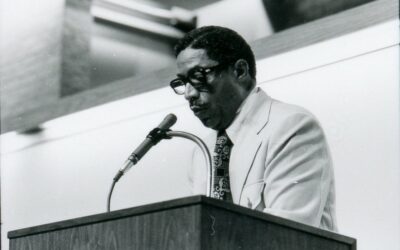
May 30 marked the end of an era for the Hogg Foundation for Mental Health as the successful five-year term of its executive director, Dr. King Davis, came to a close.
Since 1940 the foundation has served communities across Texas by promoting mental health services, research, public education and public policy. Davis came to the foundation in 2003 with a vision to maximize its impact on the Texas mental health care system by recruiting talented staff and supporting projects that would make a difference in the field of mental health.
"King Davis has been a pillar of wisdom for the foundation for the last five years," said Dr. Gregory J. Vincent, vice president for diversity and community engagement at the university. "Under his skillful management, the unit has made significant strides."
Davis brought an unusual and beneficial set of skills and experience to the position. "During my career, I have moved between academia and what I would call the practical world," said Davis, who from 1990 to 1994 served as commissioner of the Virginia Department of Mental Health, Mental Retardation and Substance Abuse.
He also served on the trailblazing Surgeon General's Workgroup on Mental Health, Culture, Race and Ethnicity and helped write a 2003 report on cultural competence for the President's New Freedom Commission on Mental Health. In 2002 he received a lifetime achievement award from the Council on Social Work Education.
These multifaceted skills gave Davis a sophisticated, comprehensive view of what the foundation could accomplish with its relatively small endowments. His academic background, clinical knowledge of mental health services and resolve to move forward with new ideas made him an effective leader and enabled the foundation to play a stronger leadership role in mental health services and policy in Texas.
"King's unique combination of skills and experiences has truly benefited the foundation and mental health consumers and organizations in Texas," said Debbie Berndt, program officer.
One of Davis' first projects was working to reduce the use of seclusion and restraint practices in Texas agencies. These techniques are used to control people's behavior but can cause both psychological and physical harm.
"This controversial practice has resulted in the impairment and death of many people," Dr. Davis said. Under his leadership, the foundation conducted a rigorous analysis of research and institutional policy to identify effective alternatives to seclusion and restraint for state agencies. The foundation has used this information to help Texas agencies adopt alternative practices and change internal beliefs and attitudes about seclusion and restraint.
Early in his tenure, Davis approached Austin Mayor Will Wynn and other community leaders to create a citywide task force that could address gaps in the region's mental health service system. These gaps, including limited access to services, most affected people from historically under-represented groups. More than 80 experts and citizens participated in the project.
Now entering its fourth year, the task force has seen measurable gains in improving crisis services, suicide prevention and overall mental health services in Central Texas. Davis and the foundation were instrumental to the success of this venture, which now serves as a model to other communities across the state.
"Seeing the positive outcomes of these early projects prompted King to carry out an extensive strategic plan that fundamentally changed how we operated," said Dr. Lynda Frost, associate director.
The strategic planning process required reflection and hard work on the part of Davis and his staff. After assessing the foundation's distribution of funds and relatively modest budget, they concluded that a far more effective approach would be to reduce the number of small-sum grants and instead award fewer grants in larger amounts.
This strategic shift in grant-making allowed the foundation to fund mental health service and policy projects with the most significant potential for impact in Texas. Together Davis and the staff identified major areas of need, building collegiality while breaking new ground in the field of mental health.
"As executive director, King helped us map out a plan that allowed the foundation to operate in new and important ways throughout Texas," said Dr. Laurie Alexander, program officer.
The team identified three top mental health priorities in Texas:
- Integrated health care, which is the collaboration of physical and mental health providers in treating patients with mild to moderate psychiatric disorders in primary care settings.
- Cultural adaptations, which adapts evidence-based treatment practices to be culturally and linguistically compatible with the needs of populations of color being served.
- Workforce development, which addresses the growing shortage of mental health professionals in a variety of fields, especially along the Texas-Mexico border and in rural and some urban areas.
According to Frost, King created an exhilarating work atmosphere in the process. "To have served this closely with King over the past five years has been a gift," she said. "He truly is a visionary."
One of the many agencies that benefited from the foundation's grantmaking priorities is People's Community Clinic in Austin. The clinic received a foundation grant for integrated health care in 2006.
"This project has been successful because the Hogg Foundation had the whole grantmaking process so well thought out," said Regina Rogoff, the clinic's chief executive officer. "We benefited from all the preliminary work done by the foundation in designing the model of care and bringing other partners in to provide technical assistance."
Another grantee, Family Services of El Paso, received a cultural adaptations initiative grant, currently in its second year. The agency's primary population is Hispanic.
Richard Salcido, executive director of the center, explained that while the center has been culturally adapting services for over a decade, the foundation's grant enabled the center to more effectively focus its evidence-based practices.
"Through this grant, we are delivering higher-quality service that is producing positive outcomes and improving quality of life for the people we serve," Salcido said. "The lessons we are learning, supported by the data we are collecting, clearly demonstrate the need to culturally adapt mental health services. These lessons learned will be valuable to providers in Texas and across the nation."
Through the foundation, Davis also promoted the annual Central Texas African American Family Support Conference to discuss disparities in mental health services to the community. The foundation's participation helped draw nationally prominent keynote speakers who increased public participation and visibility.
"Last year over 600 people attended the conference," said David Evans, executive director of Austin Travis County Mental Health and Mental Retardation Center, a conference sponsor. "King has been instrumental in the growth and success of this event, serving as a lead planner and keynote speaker to address issues of cultural competence and diversity."
While Davis is quick to point out the success of the foundation is due to the collaborative efforts of his staff, his colleagues also recognize his unique ability to solicit interest in his field. Working in the field of mental health can often be challenging. Because of the stigma attached to issues surrounding mental illness, many people shy away from even having conversations about mental health.
"I have been struck by King's ability to reach people who wouldn't necessarily care all that much about mental health," said Alexander. "Even after a brief encounter with King, they come away with a changed attitude and understanding that good mental health care is vital to everyone and something worth investing in."
Davis is returning to his position as a professor in The University of Texas at Austin's School of Social Work, where he has held the Robert Lee Sutherland Endowed Chair in Mental Health and Social Policy in the School of Social Work since 2000. While his emphasis on collaboration and cultural diversity will no doubt continue to be carried out at the foundation, his presence will be greatly missed.
For Davis, his most important legacy is a top-notch staff and the contributions they will make in the next decade. "We have experienced a great amount of renewal and transformation over the past five years," said Dr. Davis. "It has allowed us to break ground in ways that would have filled the Hogg family with pride."